
Victoria County IVSS Coverage
The current service is Texas IVSS-Counties. The Victoria County Sheriff's Office links to it, which makes the portal an official local navigation path. Texas replaced the old county VINE system with IVSS on September 1, 2025. People may still search for “VINELink” because that name was used for years, but the live Victoria County inmate check should not be described as the old product.
IVSS receives county custody, court, and supervision data as participating agencies provide it. For Victoria County, its strongest use is a search for one known person and a request for notice about a custody event. It is not the county's booking ledger, the court's certified docket, or a permanent release index. It also is not a substitute for the TDCJ offender system. A person moved from Victoria County Jail to TDCJ has left county custody while remaining incarcerated.
Note: County participation and available events can vary, so the live IVSS portal controls which Victoria County notification choices are currently offered.
Search a Victoria County Inmate
Start with an official identifier when one is known. IVSS accepts a DOC ID, SID, Jail ID, or Permanent Booking number. A name search uses first name followed by last name, and the portal suggests the first three letters of each name for a partial search. The CAPTCHA must also be completed. Names alone can produce several matches, so a result should never be assigned to a person until the available identifiers agree.
- Open Texas IVSS-Counties and select the specific-person search.
- Enter the strongest known ID, or enter the first and last name in the portal's order.
- Complete the CAPTCHA and review every returned match.
- Compare the jail or state ID and the displayed location or status before opening a record.
- Save the check time and exact wording if the result matters for later confirmation.
A location shown as “Unknown/Undisclosed” must be reported in those words. The portal says that label can reflect a pending case. It does not permit a user to infer a facility. For the broader agency-by-agency path after a name miss, use the Victoria County released inmate search.
Victoria County IVSS Result Fields
An IVSS result is a status view from a participating feed. Read it as a snapshot. The exact live interface controls which fields appear, but the researched search and notification flow supports the following distinctions.
| Field or event | What it can establish |
|---|---|
| Name and identifier | Helps distinguish the intended person from a similar name. |
| Custody or supervision status | Reports the status supplied to IVSS at the time of the check. |
| Location | Names a supplied location, or may read Unknown/Undisclosed. |
| Release notice | Records a reported custody event, not a certified release record. |
| Transfer notice | Shows movement from one custody system and may mean custody continues. |
| Notification registration | Confirms an alert request, not the person's present legal status. |
IVSS warns that someone no longer in custody may not remain in search results. A prior notification can therefore be more useful than a later blank search. Preserve its date, time, event, and agency. Then seek the jail transaction or court document that explains what happened.
The successful manifest capture comes from the official IVSS-Counties portal.
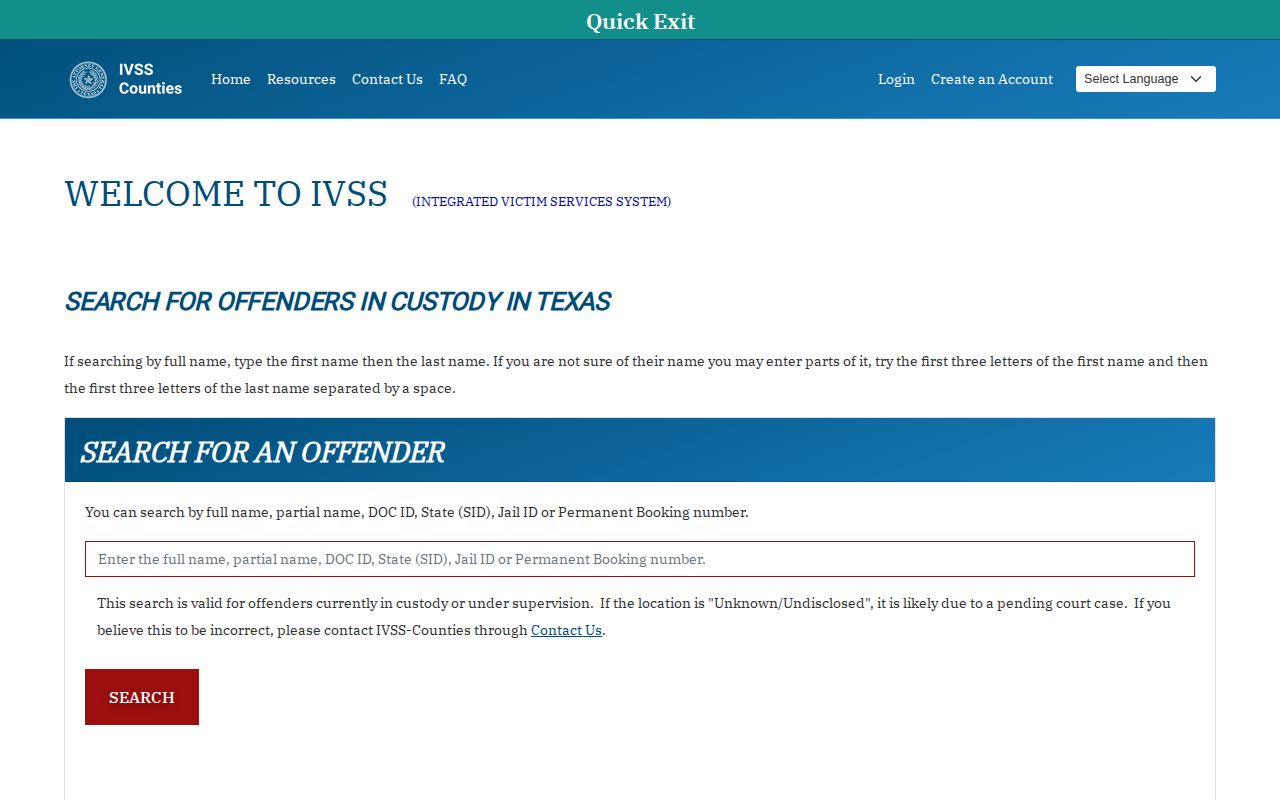
The screen supports the specific-person workflow and the warning that a person outside custody may no longer be returned.
Request Victoria County Release Alerts
Open the exact matched record before requesting notice. IVSS offers account and no-account paths, so registration does not always require a new user profile. Current contact verification replaces the legacy VINE assumption that every phone registrant creates a four-digit PIN. Follow only the prompts visible in the current portal.
- Select “Request Notifications” from the verified person's record.
- Choose the account or no-account route offered on screen.
- Enter the supported phone, text, or email contact method.
- Complete the current verification and confirmation steps.
- Set any offered language, time, and event preferences.
- Keep the confirmation and update contact details when they change.
Old VINE automated calls used a chosen four-digit PIN to confirm receipt. That is historical, not the current IVSS instruction. Existing VINE registrations were migrated, and the Texas Attorney General said users would update a password at first login. For registration trouble, IVSS provides round-the-clock help at 866-268-8959.
Why Victoria Replaced VINELink
The Texas Attorney General's victim-notification guidance documents the statewide move from VINE to IVSS. Victoria County's direct link to IVSS confirms the local side of that change. This is more than a name update. Instructions copied from older VINELink pages may point to retired screens, old county lists, or a PIN process that the current service does not use.
An existing registration may remain active even after a person drops from the visible search. It may provide notice if the person later returns to custody. That design makes sense for alerts, but it shows why IVSS is not a durable Victoria County release archive. A saved notification and a later blank search describe two system moments. Neither replaces the VCSO release transaction.
Confirm Victoria County Release Events
For an adult local booking, check the VCSO locator while the record remains returned. It shows Custody Date and Booking Status, but no clearly labeled Release Date. Quote a populated Booking Status exactly. If the record disappears, call the jail at 361-574-8044 or the sheriff's main line at 361-575-0651 for present-custody direction, then seek a written record when the exact release time, type, or destination matters.
The strongest written request identifies the person, date of birth or booking number, and booking start date. Ask for the booking sheet and any existing record showing admission, release or transfer date and time, release or disposition code, and receiving agency. The court docket can explain the legal order, but it does not prove the physical moment the jail completed release processing.
Victoria Transfers and TDCJ Checks
When an alert names a transfer to TDCJ, do not call it community release. Use the TDCJ current-inmate search with the TDCJ number, SID, or exact name. TDCJ updates on working days and covers state prison and state jail custody. Its detail can show Projected Release Date, Maximum Sentence Date, Parole Eligibility, and, later in processing, Scheduled Release Date and Scheduled Release Location.
A person released from TDCJ generally drops from that current-only interface. Historical or prior-incarceration confirmation then requires the TDCJ information email or a formal Public Information Act request. A Victoria County conviction alone does not prove service in TDCJ. The sentence may instead have involved county jail, probation, or another outcome, so compare the state result with the judgment.
Victoria County IVSS Limits
IVSS does not replace the Bureau of Prisons locator, the ICE detainee locator, juvenile channels, or a certified Victoria County court record. A federal sentence belongs in the BOP system. Immigration detention belongs in ICE records. The Victoria Regional Juvenile Justice Center handles restricted youth information through parents, guardians, attorneys, courts, and authorized agencies rather than the adult public search.
Data can also lag the act that caused a status change. A bond order may be signed before jail processing ends. A transfer can remove someone from the county feed while confinement continues elsewhere. If an IVSS alert and another record differ, preserve both timestamps and ask the originating agencies to explain their own records. That method avoids turning an automated notice into a claim it cannot support.
Match Victoria Alerts to Court Records
Victoria County Odyssey can explain the legal event behind an alert. Search the correct cause and read its chronology. A felony judgment or order comes from the District Clerk. Class A and B misdemeanor documents come from the County Clerk and County Courts at Law. City Class C documents come from Municipal Court. One person can have more than one cause, and an order in one case may leave another warrant or hold in force.
Use careful terms. “Bond set” does not mean bond was posted. A time-served order may be entered before jail staff finish discharge. A dismissal ends the named charge, not every possible restraint. Once the court record identifies the authority for release, the VCSO transaction supplies the physical time and destination. Together, the IVSS event, court order, and custody record form a sound chain.
Preserve Victoria Notification Details
Keep the confirmation issued when notifications are requested. If an alert arrives, save its exact event wording, date, time, named agency, and delivery channel. Do not rewrite “transfer” as “released” or treat a county exit as proof that all custody ended. If phone numbers or email addresses change, update them in IVSS. Blocked calls and filtered messages can prevent delivery.
An alert is most useful when it prompts a quick check. Compare it with the VCSO locator, call the holding agency, and request the underlying record if a durable answer matters. If the person returns to custody later, an existing migrated registration may still operate even though the earlier public result vanished. That behavior is another reason to treat notification history and public search history as separate evidence.